Shared housing among seniors: understanding and choosing the right option
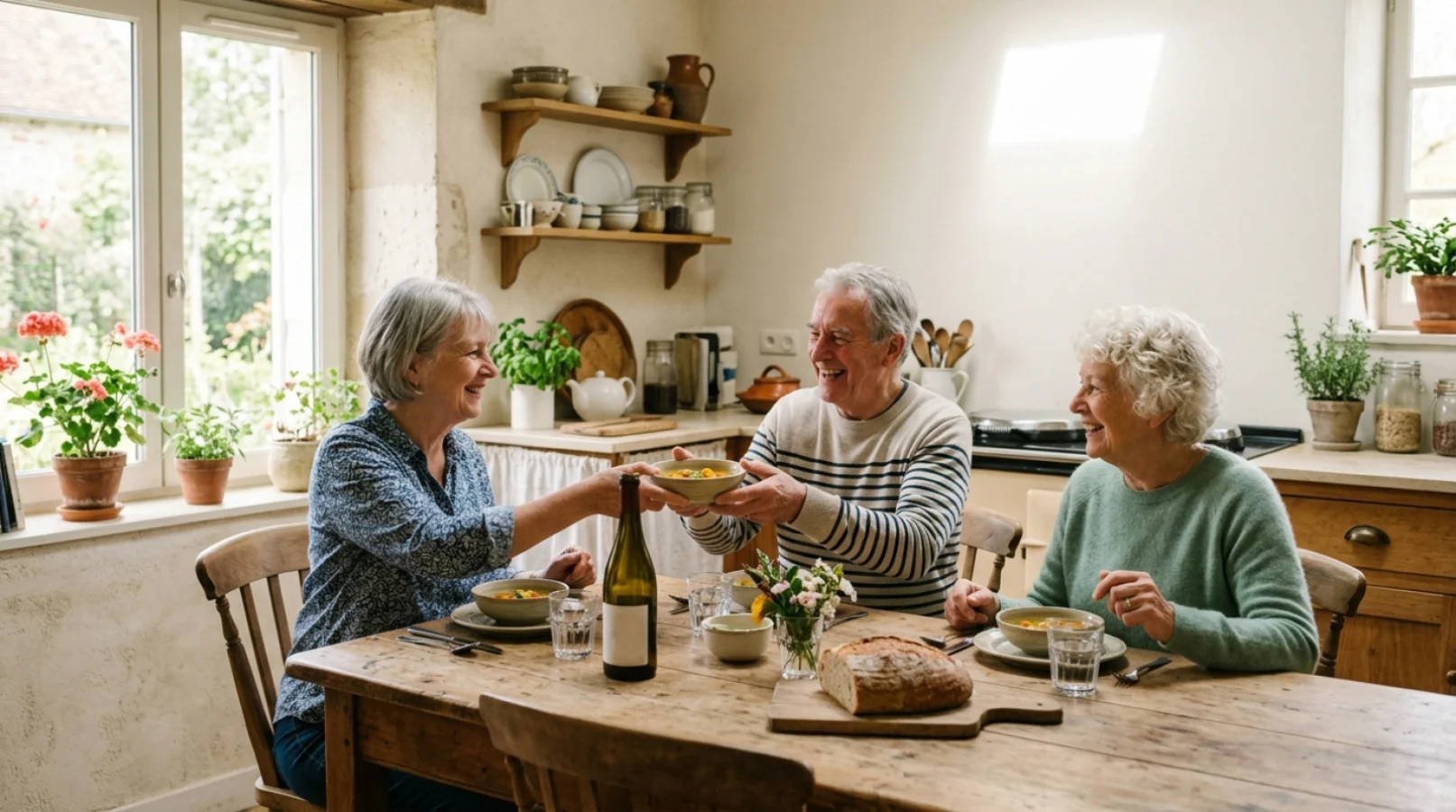
Shared housing among seniors has never been talked about so much. In June 2026, the associative network La Maison de Blandine inaugurated its third house in Isère at Faramans and announced aiming for eight openings during the year, while similar projects were emerging in Saintes, Mayenne, or Nogent-le-Rotrou. Behind this enthusiasm is a simple idea: aging without isolating oneself, living together rather than alone. But what exactly does shared housing among seniors entail, and what options are concretely available to you? Overview.
What is shared housing among seniors?
Shared housing among seniors refers to a way of living where several elderly people live under the same roof, or in the same complex, while keeping their private accommodation. Each person keeps their room or studio, and common living spaces are shared: kitchen, living room, garden, sometimes certain daily services like meals or cleaning.
The primary goal is to break isolation, which affects many seniors living alone, without giving up autonomy or privacy. It is an intermediate solution, halfway between a traditional home and a specialized facility: one remains in control of their lifestyle while enjoying reassuring presence and collective life.
Why shared housing among seniors is so appealing
Recent news clearly illustrates this dynamic. La Maison de Blandine now has nine houses open in Auvergne-Rhône-Alpes and is multiplying inaugurations in 2026. Other associative initiatives or those led by local authorities are emerging all over France. Several reasons explain this success:
Fighting loneliness: sharing daily life with others creates bonds and restores the pleasure of shared small habits.
Preserving autonomy: one continues to decide for oneself, receive loved ones, and organize the day as one wishes.
Managing budget: pooling certain expenses and mutual aid among residents often reduce housing costs.
Feeling safe: regular presence, attentive neighbors, and the possibility of supporting each other in case of need bring real peace of mind.
The main forms of shared housing among seniors
Under one expression hide very different models. It is better to know them before choosing.
Shared houses and inclusive housing
These are the projects often found in the news: houses or residences, run by associations or operators, grouping about ten or twenty seniors. A private accommodation for each, common spaces, and sometimes a coordinator or animator to bring the collective to life. It is a structured formula, suitable for people who want structured support.
Senior flat-sharing
Here, several seniors decide to share the same accommodation, like in a classic flat-share, but designed for their age and needs. One chooses their flatmates, organizes communal life together, with complete freedom. It is a flexible, economical, and friendly solution.
Intergenerational cohabitation and housing in exchange for services
Another complementary approach: a senior has a free room and welcomes a cohabitant — often a student or a young professional — who, in exchange, provides some daily services and brings presence. This is the principle of housing in exchange for services: living differently, helping each other, rather than paying full rent.
ToitChezMoi: a flexible alternative, between individuals
Institutional shared houses do not suit everyone, and places remain limited. ToitChezMoi offers a different, direct, and flexible path: a French platform for housing in exchange for services that connects hosts and cohabitants without heavy intermediaries.
Concretely, a senior who feels lonely and has a room can welcome a cohabitant in exchange for reasonable and predefined services — shopping, company, computer help, small DIY, reassuring presence in the evening. Conversely, a senior can also become a cohabitant and join another person's home. The spirit remains the same: balance, respect, and clearly framed services.
Some benchmarks that make the difference:
Registration is free; optional Premium formulas add contact and visibility.
The volume of services is capped at 15 hours per week (often 10 to 15 h depending on the situation), to preserve everyone's balance.
Services are defined in advance and, preferably, formalized in a written agreement.
To explore this option, you can offer a room as a host or look for housing in exchange for services near you. And if intergenerational cohabitation interests you, our dedicated page on senior and intergenerational flat-sharing details how it works.
Frequently asked questions about shared housing among seniors
Is shared housing among seniors reserved for dependent people?
No. Most formulas are aimed at autonomous seniors who simply want to live accompanied rather than alone. Housing in exchange for services, in particular, is based on daily mutual aid and not on medical care.
How much time must a cohabitant dedicate to services?
On ToitChezMoi, the volume is limited to a maximum of 15 hours per week, with a common range of 10 to 15 hours depending on the situation. The idea is that everyone finds their balance, without imbalance.
Is it necessary to sign a document?
It is strongly recommended. Putting in writing the expected services, shared spaces, and rules of life avoids misunderstandings. Consult the security guide and contract templates before committing.
Do you have to pay to reserve housing?
Never before visiting the accommodation, meeting the person, and verifying that everything meets your expectations. It is an essential rule of caution.
In summary
Shared housing among seniors covers a wide variety of solutions, from associative shared houses to flat-sharing between individuals, including intergenerational cohabitation. Everyone can find the formula that suits them. If you prioritize flexibility, direct connection, and mutual aid, housing in exchange for services between individuals is worth considering. Register for free on ToitChezMoi to offer a room or find more humane housing near you.