Free Room in Exchange for Services: What to Check Before Saying Yes ?
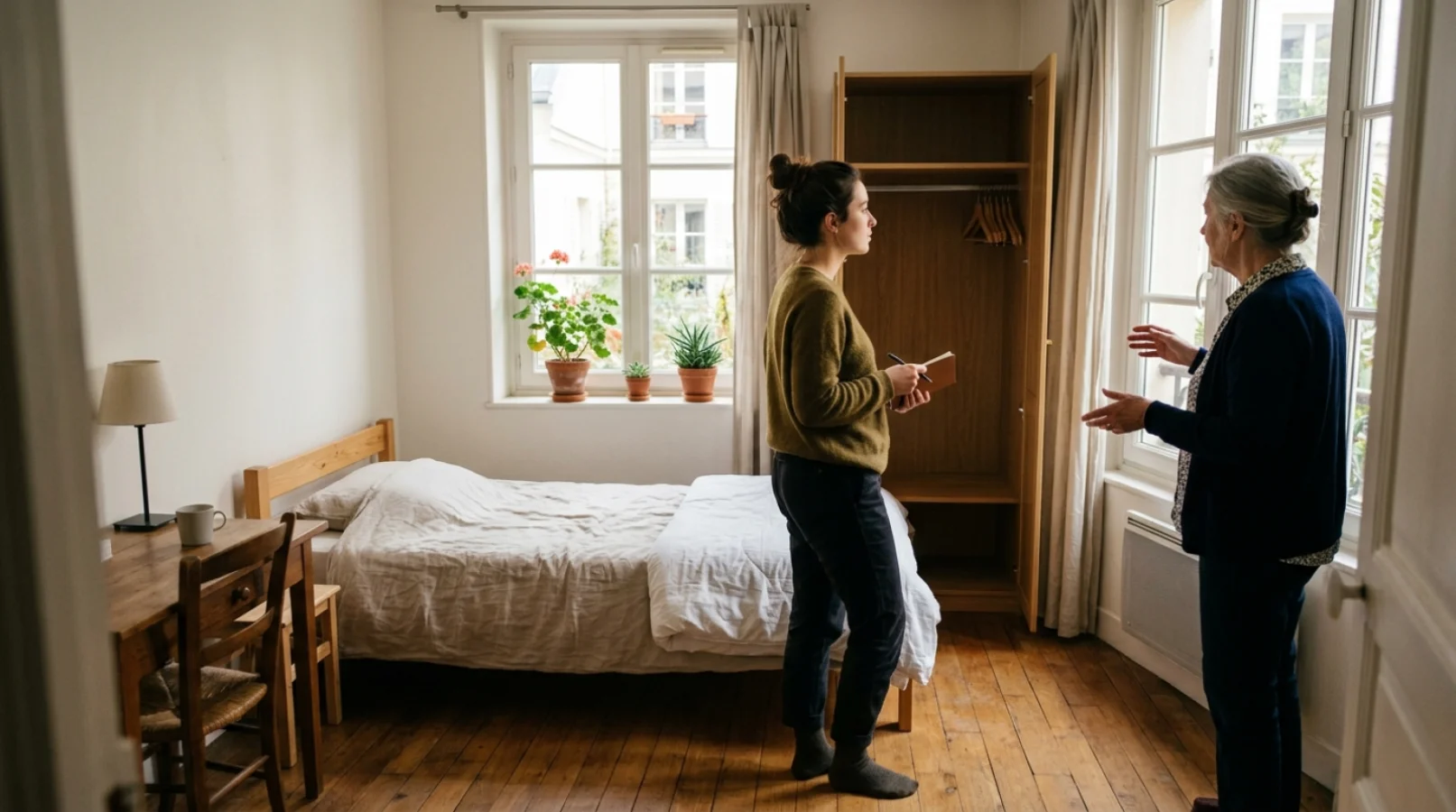
You have been offered a free room in exchange for services: no rent to pay, in return for providing your Host with regular help. The arrangement sounds clear, your first conversations have gone well and the services seem manageable. But there is one essential part of the agreement that is sometimes overlooked: the room itself. Its actual size, natural light, heating, privacy, access to the bathroom and overall condition will shape your everyday life.
Before agreeing to housing in exchange for services, it is therefore essential to inspect the accommodation properly. A promising relationship with a Host does not replace the need to make sure that the room is suitable, safe and compatible with your needs.
This guide focuses on one of the most important steps before reaching an agreement on ToitChezMoi: visiting the accommodation, meeting in person and checking the living conditions. It is designed both for Cohabitants visiting a potential room and for Hosts preparing to welcome someone into their home.
Free accommodation in exchange for services: what does “free” actually mean?
A free room in exchange for services is not simply a room given away without anything in return. The accommodation is provided without rent in exchange for everyday services agreed in advance between the Host and the Cohabitant.
Depending on the arrangement, these services might include companionship or reassuring presence, shopping, light household help, school pick-ups, homework support, gardening, pet care or basic computer and administrative assistance.
The key principle is simple: the Cohabitant contributes time and agreed services rather than rent.
Before even visiting the accommodation, three points should be clear:
- The amount of help expected: ToitChezMoi sets a maximum of 15 hours of services per week, with 10 to 15 hours being a common range.
- The value of those hours: for arrangements in France, ToitChezMoi used the French gross minimum hourly wage of €11.88 in 2025 as an indicative benchmark. At 10 hours per week, this represented approximately €514 per month. This figure is only a reference point, changes over time and is mainly useful for assessing whether the exchange remains balanced.
- Household costs: electricity, heating, water and internet still need to be considered. A rent-free room does not automatically mean that every household expense is included. The way these costs are shared should be discussed and put in writing.
For a broader explanation of the model, you can read the ToitChezMoi guide to housing in exchange for services.
Even without rent, the room still needs to provide suitable living conditions
This is an important point to understand: the absence of rent does not mean that any room can automatically be considered suitable accommodation. A room intended to become someone's home should provide safe, healthy and appropriate living conditions.
The precise legal requirements depend on the country where the accommodation is located. Because ToitChezMoi is based in France, French housing standards provide an important reference point for arrangements taking place in France.
In France: the decent housing requirements
For accommodation located in France, the space provided for someone to live in must comply with the applicable requirements for decent housing. These standards cover not only the dimensions of the main living space, but also essential aspects of health, safety and everyday use.
Among the main points to consider under French housing standards are:
- a main living space of at least 9 m² with a ceiling height of at least 2.20 metres, or a minimum habitable volume of 20 m³;
- appropriate natural light and ventilation, heating, electricity and equipment compatible with residential use;
- no obvious risk to health or safety, such as serious damp, water infiltration or pest infestation;
- access to essential facilities such as sanitary facilities and equipment allowing normal everyday use of the accommodation.
The official French requirements are set out in the decree on decent housing published on Légifrance. The official legal text is available in French.
In particular, Article 4 establishes the French minimum of 9 m² with a ceiling height of at least 2.20 metres, or a minimum habitable volume of 20 m³. These are French legal criteria and should not automatically be applied to accommodation located in another country.
Outside France: housing standards vary from country to country
If the accommodation is located outside France, the same practical questions remain important, but the applicable legal standards may be different. There is no single international definition of what makes a room legally suitable for habitation.
As a general rule, anyone considering housing in exchange for services abroad should check the official housing requirements in the country — and, where relevant, the region or city — where the accommodation is located.
England provides a useful example. Rather than applying the French minimum room dimensions, English housing law includes its own standards for determining whether rented accommodation is fit for human habitation. Under the Homes (Fitness for Human Habitation) Act 2018 guidance, factors such as serious damp, insufficient natural light, inadequate ventilation, unsafe layouts, problems with hot and cold water, drainage, sanitation and facilities for preparing food can be relevant when assessing whether a property is fit to live in.
England also uses the Housing Health and Safety Rating System (HHSRS) to identify and assess potential risks to people's health and wellbeing in residential properties.
The exact rules therefore vary, but the underlying principle is similar: a room should provide a safe, healthy and genuinely usable place to live.
Whether you are viewing accommodation in France or elsewhere, pay particular attention to small attic rooms, converted spaces, mezzanines and rooms with limited natural light. A space that looks acceptable in photographs may feel very different once you are standing inside it.
Checking these details during the visit is far better than discovering a serious problem several weeks after moving in.
8 things to check when viewing a room in exchange for services
A viewing may last only 20 or 30 minutes, and it is natural not to want to appear overly demanding. But checking the room carefully is not being difficult: it is part of making sure the arrangement can work for everyone.
These eight points can usually be checked discreetly in just a few minutes.
- Check the actual size and ceiling height. If necessary, bring a tape measure or use a measuring app. A room advertised as “around 10 m²” may offer considerably less usable space once sloping ceilings, built-in cupboards or other restrictions are taken into account. Remember that minimum room dimensions and legal definitions vary between countries.
- Look at natural light and ventilation. Open the window rather than simply checking that one exists. Does it open properly? Is there sufficient ventilation? Look for signs of damp or mould, particularly in corners, around the window and behind furniture.
- Check the heating. Identify the radiator or other heating system and ask how warm the room normally is during winter. Who controls the thermostat? A room that feels perfectly comfortable during a summer viewing may be very different in January.
- Think about privacy and whether the room closes properly. Does the bedroom door close? Is there a lock or key, and who has access to it? Privacy is an essential part of successful shared living. The Cohabitant's room should be treated as their private space, and the rules around entering it should be clear from the beginning.
- Confirm exactly which furniture is included. Check the bed and mattress, storage space, desk or table, accessible electrical sockets and Wi-Fi coverage inside the room. Ask which items will remain after you move in and whether the Host intends to remove anything currently shown.
- Understand how shared spaces work. How many people use the bathroom? Can you use the kitchen whenever you need to? What about the fridge, washing machine and living room? Establish which spaces you can use and whether there are particular household rules or schedules.
- Pay attention to noise and movement through the home. A bedroom next to a busy living room or immediately beside the Host's room may offer a very different experience from a more independent space. Check whether anyone needs to pass through the room to access another part of the property. During the viewing, spend a few seconds simply listening to the room.
- Check the practical details. Do you have an independent entrance or share the main entrance? How will you receive post? Is there somewhere to store a bicycle? Is parking available if you need it? If you require proof of accommodation for administrative purposes, ask whether the Host will be able to provide the appropriate documentation.
Questions to ask during the viewing
You are not simply choosing a bedroom. You are also considering the everyday living arrangement that comes with it.
The visit is therefore a good opportunity to discuss the practical side of the exchange before putting the final agreement in writing.
- Exactly which services are expected, how often and at what times?
- How many hours of services will be expected each week in total?
- What happens during exam periods, holidays or when the Host is away?
- What are the household rules regarding visitors, pets, smoking or coming home late?
- How long is the arrangement expected to last?
- What notice period would apply if either person wanted to end the arrangement?
You can also attend the viewing with someone you trust. If that makes you feel more comfortable, simply let the Host know beforehand. A friend or relative may notice practical details that are easy to overlook when you are hoping that a particular room will work out.
For Hosts: how to prepare the room before the first viewing
A well-prepared room does more than create a good first impression. It helps potential Cohabitants understand exactly what is being offered and encourages more serious, informed applications.
Before advertising the room or arranging a viewing:
- Make sure you are entitled to offer the room. If you rent your home, check your tenancy or lease agreement and the rules that apply where you live. Depending on the country and your situation, permission from the property owner may be required.
- Check the room against the applicable housing standards. Consider its usable area, ceiling height, natural light, ventilation, heating and electrical safety. The exact legal criteria should be checked according to the country where the accommodation is located.
- Clear and properly equip the room. A bedroom that is still being used for storage does not give the impression that someone can genuinely make it their own.
- Describe the accommodation honestly. Your listing should clearly explain the bedroom itself, bathroom and kitchen access, heating, storage, privacy and the rules for using shared areas.
- Speak to your insurer. Explain the actual situation: you will be sharing your home, making a room available and welcoming a Cohabitant for an agreed period. Insurance requirements may vary by country and policy.
- Prepare an inventory and condition report. Photographs of the room and a list of the keys handed over can help establish its condition at the beginning of the arrangement.
Hosts can find more information about the process on the ToitChezMoi page for offering accommodation in exchange for services.
What should be put in writing — and which warning signs should you never ignore?
A written agreement is strongly recommended because it helps both the Host and the Cohabitant understand exactly what has been agreed. Whether a particular contract or legal form is required will depend on the country and the nature of the arrangement.
The document should clearly describe:
- the room and shared spaces being provided;
- the services expected;
- the number of hours involved and the agreed schedule;
- how household costs will be handled;
- the main household rules;
- the expected duration of the arrangement;
- the notice period;
- the conditions for ending the arrangement.
An inventory and condition report is also advisable whenever a furnished room and household equipment are being provided. It creates a shared record of the room's initial condition, the furniture included and any existing damage.
For arrangements in France
In France, the appropriate legal framework can vary depending on the situation. An agreement may, for example, take the form of a prêt à usage — also known as a commodat under Articles 1875 to 1891 of the French Civil Code — an au pair-type arrangement, or a furnished rental combined with services when reduced rent is also paid.
ToitChezMoi sets a maximum of 15 hours of services per week. If the services exceed this threshold, or if their value becomes greater than the usual rental value of the accommodation, an employment framework may become relevant. In France, Hosts and Cohabitants should seek guidance from URSSAF or the appropriate public authorities if there is uncertainty about the correct legal status.
For accommodation outside France, Hosts and Cohabitants should check the contractual, housing and employment rules applicable in the country concerned rather than assuming that the French framework applies.
ToitChezMoi also provides contract and inventory resources to help both sides formalise their arrangement.
Warning signs that should make you stop and reconsider
Most housing arrangements begin with normal discussions and sensible questions. However, some situations should immediately raise concerns:
- someone asks you to send money to “reserve” the room before you have visited the accommodation and met the Host;
- the Host refuses to arrange a viewing or claims to be abroad while offering to send you the keys;
- the photographs do not appear consistent with the address or the actual room is never shown;
- the list of services keeps increasing during each conversation or remains deliberately vague;
- someone insists that you leave the platform's messaging system immediately after making contact;
- there is any suggestion that intimate or sexual activity could form part of the exchange.
If something feels unclear, do not allow the need for accommodation to pressure you into making an immediate decision. You can also consult the ToitChezMoi safety guide for additional precautions.
Frequently asked questions about free rooms in exchange for services
Does a rent-free room still need to meet housing standards?
Housing standards depend on the country where the accommodation is located. In France, accommodation must meet the applicable French requirements for decent housing. Other countries have their own standards. In England, for example, housing legislation considers factors such as damp, natural light, ventilation, sanitation and other health and safety hazards when assessing residential conditions.
Does the French 9 m² minimum apply everywhere?
No. The minimum of 9 m² with a ceiling height of at least 2.20 metres, or a minimum habitable volume of 20 m³, comes from French housing rules. It should not be presented as an international standard. If the accommodation is outside France, check the official rules applicable in that country or region.
Can I view the room before agreeing to move in?
Yes, and doing so is strongly recommended. A viewing allows you to confirm that the accommodation exists, inspect the room and shared spaces, meet the Host and ask important questions before making a commitment.
Tell someone you trust where you are going and, if it makes you more comfortable, ask whether you can bring someone with you.
How many hours of services can be expected for a free room?
On ToitChezMoi, the platform sets a maximum of 15 hours of services per week, with 10 to 15 hours being a common range. The expected number of hours should be clearly quantified and written down rather than left to evolve informally after you move in.
For arrangements outside France, the applicable employment and housing rules should also be checked locally.
Do we need a written agreement?
A written agreement is strongly recommended. It should set out the accommodation provided, duration, services, hours, household rules, costs and conditions for ending the arrangement.
The exact legal requirements and the appropriate type of agreement can vary by country. Adding an inventory and condition report also provides a useful record of the room and equipment at the start of the stay.
I rent my home. Can I offer a room in exchange for services?
Check your tenancy or lease agreement first. The rules depend on the country, the property and the terms of your agreement. If permission from your landlord or property owner is required, obtain it before advertising the room.
Is it free to join ToitChezMoi?
Yes. Creating an account and profile on ToitChezMoi is free. Optional Premium plans are available to expand contact opportunities and profile visibility. You can find further information in the ToitChezMoi FAQ.
A properly checked room is the foundation of a successful living arrangement
Housing in exchange for services works best when both people know exactly what they are offering and receiving: a suitable room described honestly on one side, and clearly defined services on the other.
The legal details may change from one country to another, but the practical questions remain remarkably similar. Is the room safe? Is it properly ventilated and heated? Will the Cohabitant have enough privacy? Are the shared spaces genuinely accessible? Are the services clearly defined? And do both people understand the arrangement in the same way?
The 20 minutes spent checking the size of the room, opening the window, testing the practical arrangements and asking the right questions can prevent weeks or months of frustration later.
A successful arrangement is not simply about finding a free room or someone willing to help around the home. It is about creating living conditions in which both the Host and the Cohabitant feel comfortable, respected and clear about their commitments.
If you are looking for this type of arrangement, you can explore housing in exchange for services for Cohabitants and start looking for a suitable Host on ToitChezMoi.